Several of our US Education Group people booked a tour bus for a little sight-seeing around Almaty today. It's a decent sized 'burgh, well developed.
First stop was at some kind of memorial across from the former Soviet KGB Headquarters. The apple in front represents one of the things for which Kazakhstan is known for (haven't tried one yet). At a memorial across the street was a statue to the Golden Man of Kazakhstan. Tradition has that you must kiss the book at the base of the statue. I faked it. Also included are various scenes from Kazakhstan's history. Then we visited a Russian Orthodox Church, St. George. Or maybe is was St. Stefan. Or St. Cloud. I really have no idea. It's supposedly the largest building in the world build without the use of nails. Only wooden pegs. Photos were forbidden inside, but I snapped off a shot of their vision of hell (My vision would be to sit through one of the services). Say what you will about hell at least we'll be surrounded by naked women. Of course they won't be in the best frames of mind, but how is that different from now?
Finally we drove about ten miles outside Almaty to the Medeu Arena, highest elevation speed skating rink in the world (1691 meters) and site of the 1980 Olympics. Medeu Dam located up the canyon protects from devastating mudslide which occur periodically. Various sources state the number of steps up the dam as 830/831/842/950/1000, take your pick. Of course I climbed them.
About Me
Friday, March 29, 2013
Baku, Azerbaijan
I first came here in 2005. Eight years on I barely recognize the place. Oil money from the Caspian Sea fields has made itself felt in a huge way. Back then Baku had a very old world, post-Soviet feel to it. Now it is ubër modern, high end shopping, foo foo Euro-chic clothing styles.
If you look closely at the last photo you can still see a hammer and sickle from the Soviet times on the front of the building. Otherwise you'd never know about it.
Labels:
Azerbaijan,
Baku
Sunday, March 24, 2013
To the Untrained Eye...
This would appear to be the result of a couple sloppy guys just throwing their clothes all over a room with no regard for cleanliness or order. In fact nothing could be further from the truth.
Having finished a daily workout Mark and Mike dutifully washed their exercise togs and just as dutifully laid them out on the HEATED FLOOR to dry. Why has this concept not reached American shores? I'd MUCH rather have a heated bathroom floor than a dishwasher or garbage disposal or lights.
And for a guy with a tendency to have cold feet this is pure joy.
Having finished a daily workout Mark and Mike dutifully washed their exercise togs and just as dutifully laid them out on the HEATED FLOOR to dry. Why has this concept not reached American shores? I'd MUCH rather have a heated bathroom floor than a dishwasher or garbage disposal or lights.
And for a guy with a tendency to have cold feet this is pure joy.
This is an actual place.
I'm pretty sure it's abandoned and rightfully so. But this pile is next door to my hotel in Almaty. The world can be divided into two kinds of people, those who think clowns are funny, great and entertaining and those who are sane.
All it needs now is a film crew to start making a horror movie.
Mr. Ed is Dead
And he was delicious! Horse steak is popular here in Kazakhstan. I had imagined a T-bone looking chunk of meat, but in the event they turned out to be medallions. Still it was quite a tasty sandwich.
Not sure why our cultural aversion to dining on My Little Pony exists. In my mind the equine is about the equivalent.
Room Service!
Our room in Almaty, Kazakhstan had no mini-bar. This is a problem. Hotel asked us if we wanted to change rooms. No, that's not necessary. Could you bring us some sodas and a couple bottles of water? No problem.
They were luke cold, but will do. Small problem.
Hotel offered to let us use THEIR fridge in the kitchen.
Problem solved.
They were luke cold, but will do. Small problem.
Hotel offered to let us use THEIR fridge in the kitchen.
Problem solved.
Saturday, March 23, 2013
Ahh, FashionTV!
One of many little known joys of international travel is FashionTV. This channel is seen from Middle East to South Asia to Central Asia (where I am now) to China and points beyond.
There is no plot to any of it except for airing videos of various fashion shows throughout the world. I've never seen a video with actual dialogue. Just model after endless, long-legged model parading one after another to a background of bland music.
But in its own way it's an awesome phenomenon. I submit Exhibits A and B (seen below) Your Honor. No false modesty. No attempt at informing the public. Just good wholesome viewing.
This was taken from the TV in my room moments after arriving in Almaty, Kazakhstan at 4:15AM.
There is no plot to any of it except for airing videos of various fashion shows throughout the world. I've never seen a video with actual dialogue. Just model after endless, long-legged model parading one after another to a background of bland music.
But in its own way it's an awesome phenomenon. I submit Exhibits A and B (seen below) Your Honor. No false modesty. No attempt at informing the public. Just good wholesome viewing.
This was taken from the TV in my room moments after arriving in Almaty, Kazakhstan at 4:15AM.
Friday, March 22, 2013
In honor of World Water Day...
I'm following the example of noted philosopher, philanthropist and philander W. C. Fields who famously stated of the life-giving liquid, "Ah yes, water. I never drink anything fish (fornicate) in."
And the world is a better place for it.
Tuesday, March 19, 2013
Not to Beat a Dead Horse but...
On this observance of the 10th anniversary of the start of the Iraq War may I continue to ask what statement by then Vice-President Darth Cheney ever turned out to be true?
"We will be greeted as liberators." "We know Saddam has weapons of mass destruction." "We know there are ties between Saddam and al Qaeda." "Oil revenues will fund the costs of the war."
These are just a few of his more notable burblings.
He along with his puppet George Bush should be charged with war crimes. The damage they have done to the US and the world will not be undone for generations.
I try not to have bad feeling toward anyone. But these two, along with Rumsfeld, Wolfowitz, Rove and host of others turn my stomach.
"We will be greeted as liberators." "We know Saddam has weapons of mass destruction." "We know there are ties between Saddam and al Qaeda." "Oil revenues will fund the costs of the war."
These are just a few of his more notable burblings.
He along with his puppet George Bush should be charged with war crimes. The damage they have done to the US and the world will not be undone for generations.
I try not to have bad feeling toward anyone. But these two, along with Rumsfeld, Wolfowitz, Rove and host of others turn my stomach.
Spring Comes to Seattle
Took this outside my apartment. It's still cool. Highs in the upper 40s, lower 50s. But nice weather isn't far off.
Monday, March 18, 2013
Here's a Job You Couldn't Pay Me Enough to Do!
Saw this fella washing windows at my apartment today. Wonder how much an hour he makes? Here's the thing, while there isn't enough money in the world to get me to clean windows hanging from that line, I'd probably pay good money to slide over the edge down to the street. Although, at 25 stories I believe that would be my longest rappel ever. Less than my bungee though.
Good luck to him I say!
Saturday, March 16, 2013
Saturday Morning Kicking Around Seattle
So this morning I decided to finally ride the Seattle Great Wheel. If you look in the upper left-hand corner of the building in the lower right of the photo, my apartment can be seen. I put a sheet of paper, which you can barely see, in my window. I want to ride the Wheel on some clear warm summer night.
The umbrella I saw when I was walking around downtown.
Friday, March 15, 2013
Back to MEF
Second Flight Test of Boeing 787
OK, I didn't actually see this. "Borrowed" it from the Flight Aware web site. But these planes pass by my place on their way to Boeing Field all the time. Mt. Rainier is a stretch to see from my apartment (I'd probably fall to my death if I leaned out far enough to get a look).
Just a cool photo.
Just a cool photo.
Thursday, March 14, 2013
My digs
I saw this shot on Pinterest and just loved it. Haven't ridden the "Great Wheel" yet, but plan to on Saturday. I'll take more photos then. You can see my apartment in this picture. It's the one with the bicycle on the porch. Ha! Ha!
Wednesday, March 13, 2013
Tuesday, March 12, 2013
Deja Vu All Over Again
Having just returned from my latest whirlwind pass through the sub-continent I am fighting off the usual jet lag blues.
The afternoon of my first day back I opted for a little nap. About an hour in to it my phone rings. It was the airline informing me that my bag which had been re-routed from me was now in and would be delivered to my Seattle address.
I started! "No! That's no good. I'm not in Seattle! I'm in, uh, er. Oh. (Looking out the window) Huh, I AM in Seattle. OK. Thank you."
This temporary post-trip disorientation always happens at some point. This was just the first time anyone else experienced it with me. Wonder what the poor guy was thinking...
The afternoon of my first day back I opted for a little nap. About an hour in to it my phone rings. It was the airline informing me that my bag which had been re-routed from me was now in and would be delivered to my Seattle address.
I started! "No! That's no good. I'm not in Seattle! I'm in, uh, er. Oh. (Looking out the window) Huh, I AM in Seattle. OK. Thank you."
This temporary post-trip disorientation always happens at some point. This was just the first time anyone else experienced it with me. Wonder what the poor guy was thinking...
Monday, March 11, 2013
My First Look at the Himalayas
On my recent trip to Nepal I booked an early morning flight on Buddha Air to view the mountains. There isn't much I can say to add to the photos. We were at 25,000 feet, still below the top of Everest. Stunning. In the first photo, looking out the cockpit window, Everest is seen roughly to the left of center.
And yes, there is a Yeti Airlines which does similar flights. Given the choice I went with karma. But it was a tough decision.
Sweet Home Seattle!
These are a couple views from my apartment. Puget Sound. Olympic Mountains in the distance. It's a good place.
Saturday, March 09, 2013
An Experimental Post if you Will
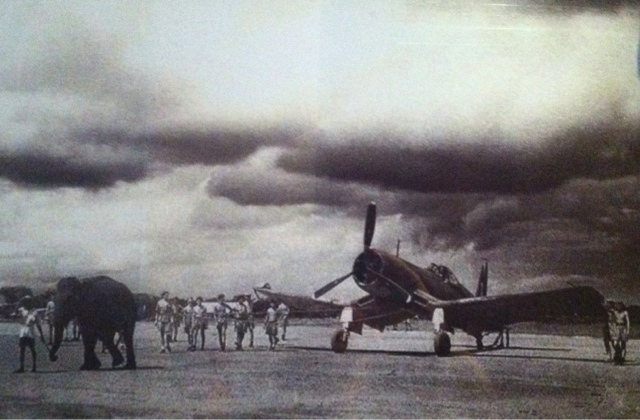
Adding a photo of a photo I took in the Hotel Suisse in Kandy, Sri Lanka. An elephant pulling what I believe is a Spitfire, circa WW II.
Trying to Get Back in the Blogging Habit
It suddenly dawned on me there is probably an iPad app for Blogger. And in fact there is. Having downloaded it I will now make every attempt to revive the moribund "Best of What's Left."
You can thank me later.
Sunday, August 12, 2012
The Olympics: In My Opinion
So the games of the something or other Olympics have ended. Only the closing ceremony remains. Due to a recent move we have no cable or satellite hookup, so I won't be watching.
No matter. I saw the opening. After Beijing I knew it would be a tough show to follow. No one, and I mean NO ONE does opening ceremonies like the Chinese. But the London opening was interesting...and odd. The whole Industrial Revolution thing was a strange theme. Funny how they skipped over the colonialism and the slave trade. Those had as much or more to do with Britain's rise to a world power as anything else.
But that's water over the bridge.
Now as to the games themselves, I have my personal preferences and dislikes. Which I will share with you now. I realize I may be opening myself to criticism and accusations of sports snobbery and I don't know what else. But certain things need to be said. If I were appointed Czar of the International Olympic Committee there would be big changes.
Now, I am not alleging that certain events are not difficult to perform. Jason. That's not the point. It's the kind of "making up" of sports to fit into the games I object to.
So for instance, any "sport" with the words Synchronized or Rhythmic in them would be abolished. You all know this. They aren't really sports. Seriously, if ribbons or hula hoops are involved: Out.
Any sport with a "Kiss and Cry" corner. Gone. I mean come on. Again, I'm not saying this stuff isn't hard to do. It's just that the whole thing depends on the judgement of some ideological nitwit or potential child abuser with a grudge to determine the winner. Although I'm writing about the Summer Games this goes for figure skating too.
Essentially any sport where you feel the need to wear glitter and ridiculous eye makeup (Eastern Euros) has to be shown the door.
I realize I may be doubling up here.
Moving on, soccer: Out. Soccer (aka futbol)has both mens and womens world cups. Those are HUGE, vastly entertaining events in and of themselves. Olympic soccer doesn't have half the value.
Basketball: Gone. I know this is usually a lock for the US. They should just automatically award the Americans the Gold and let everyone else play for Silver or Bronze.
Any sport that requires another species. Aka Dressage. This is what county fairs and rodeos are for.
Air rifle. Shoot a real weapon.
Boxing. Gotta go. Its a great sport with a great Olympic tradition. But the game is so crooked, the matches so fixed its lost all its allure. Can it.
Same apparently goes for badminton. Ping pong, I mean table tennis, too. A third of the planet plays it so it will be around for a while.
That indoor cycling sprint relay thing where I can't figure out what they're doing and its over in 20 seconds. Lose it.
I like the kind of recent tradition of having the womens marathon being the first track and field event with the mens coming last. A nice bracket. I'm basically a track and field fan. To me THAT is the Olympics.
The Olympic motto is "Citius, Altius, Fortius." Faster, higher, stronger. Stick with events that fall under that.
So swimming stays. Rowing stays. As an aside I noticed some of the teams had Concept II oars. I bought a prototype Concept II rowing ergometer from two grad students at Northeastern University who developed it in 1981. Glad to see they're going strong.
Most races stay. Even the triathlon, although I have a little problem because it isn't run the full Ironman distance. The 26 mile 385 yard marathon is that unusual distance because in the London games of 1908 organizers wanted the race to start near Windsor Castle so the royals could watch. Due to the need to stretch the course distance from a planned-on 25 miles it became the Olympic distance. The triathlon became a famous race because of the Hawaiian Ironman. THAT's the distance that should be used.
Also on the branding thing (which has absolutely nothing to do with my enlightened leadership), since the Olympics has become a whore for advertising value,you may or may not have noticed the Chinese brand Li-Ning prominently displayed on jerseys, shoes and other accouterments. I believe Li-Ning will in the near future be as ubiquitous as Nike, Adidas and Puma. I've purchased several Li-Ning shirts and shoes when I was in China and found them to be of very high quality and good value.
Any of the currently existing races and feats of strength stays.
Under my leadership the whole shebang will take about six days.
So the Tour de France is over. The Olympics is over. Tiger Woods is over.
Hey the Pirates still have a shot at the playoffs. I haven't been able to say that for twenty years!
Saturday, January 14, 2012
Hi. Yeah I'm back.
When I hear conservatives saying "We need to make this country great again" I wonder...what the hell do they mean?
Define great. Does that mean, what, we roll all over every other country? We kind of already do that.
Should we have the highest rate of conspicuous consumption, energy and resource use of every other civilization that ever existed? Been there, done that.
And IF there is a way to make this country great again (what ever that means) how do they propose to do that with the likes of Ricks Perry or Santorum, Newt Gingrich or Willard Romney at the helm? Maybe Colbert could pull it off. He gets my vote. If I voted Republican, fat chance.
Define great. Does that mean, what, we roll all over every other country? We kind of already do that.
Should we have the highest rate of conspicuous consumption, energy and resource use of every other civilization that ever existed? Been there, done that.
And IF there is a way to make this country great again (what ever that means) how do they propose to do that with the likes of Ricks Perry or Santorum, Newt Gingrich or Willard Romney at the helm? Maybe Colbert could pull it off. He gets my vote. If I voted Republican, fat chance.
Friday, September 23, 2011
Friday, July 08, 2011
Now It Can Be Told...
May 19th, 2011 I received the payoff from the sale of my house. The place had been on the market since January 2007. On other words straight into the teeth of the most massive real estate downturn in U.S. history. Had I tried to sell it one year earlier odds are I would have sold it much easier and for (I estimate) double what I eventually received.
But OK, that's history. Others had it far worse. Life marches on.
But there's a heck of a story leading up to the actual sale.
We were in China. This was last February. At the Wudang Taoist Kungfu and Taiji Academy foreign students come from virtually everywhere in the world. They do so for all manner of reasons and lengths of stay. Some we became close to. Others not so much. It depended largely on how long they were around (often only a week or so) and of course personality.
Over the winter, when it was very cold, the number of students dropped to maybe six or seven students. So we all tended to bond together more so than in the spring or summer when the roles would swell to three or four dozen folks.
Around the first of the year we had been joined by a French woman whom I'll refer to as Dana, a very pleasant, jovial lady, who was always a joy to be around. She had been with us for close to two months when it came her time to leave.
On her last night in Wudang several of us gathered in her room for a bit of socializing and to bid her a safe journey. We had some snacks and a bottle of "Great Wall" wine. A very pleasant evening. In the event I was telling her my basic life story, lamenting the difficulty in unloading the house. I actually did have a buyer who was living in the house paying me on a "Bridge loan" until he could qualify for bank financing. But the contractual time limit for the financing had expired and even though I had agreed to extend the limit it was looking unlikely anytime soon. I had a constant fear of learning he had moved out with no forwarding address (It had happened before on an earlier sale attempt).
At this juncture I should mention that Dana is a self-described Shaman (Shawoman?). No, Shaman. That in itself is a very interesting yarn. But it's hers, so I'll roll on with mine.
So I'm giving her the sorry details when she asks me to hand her some cards she had laying on a nearby table. They were little, business card-sized things. Laminated and connected with a kind of ring as I recall. She also had a little pyramid-shaped charm, like you'd see on a decorative bracelet. She began waving the pyramid over the cards and having a private conversation in French, which I couldn't understand. It seemed as though she was asking some questions, making the odd comment, occasionally nodding her head as if in response to something.
After a minute she looked up and said "You have a ghost in the house. It doesn't want the house to sell. Until you get the ghost out the house won't sell."
I was stunned! But the shock was just beginning. So, who is this ghost? Turns out it was my mother-in-law! I will tell you that in my story I had mentioned how my mother-in-law had lived in the attached apartment for several years, but a few years before her death had moved in with her surviving daughter. Some might say "Aha! She picked up on that and used it to 'work' you." OK, maybe so. But in the end I don't care. I'm not one for mumbo-jumbo, metaphysical crapola. As a rule I don't buy into Aliens, Yetis or spirit world/human interaction. But read on...
"How could this be!" I asked. She didn't die in the house! Dana replied it wasn't necessary to have passed away there. She explained how the spirit of those "beyond" sometimes go back to a place where they were happy during their physical life. I knew my mom-in-law had loved her little apartment, so that made sense as far as it went.
"What about my wife? She actually DID die in the house. Was she still there?"
No, she has moved on. In the spirit world she is not Jan as you once knew. She is a different "facet" of her spirit. But she is happy and well and wishes you good things (I'm paraphrasing.)
"So what do I do?" I asked.
Dana gave me explicit instructions. I needed to write a letter to my mother-in-law, read it to her aloud, burn it and spread the ashes into the hillside. Even though I was in China the message would be delivered.
I looked at Cabrini and said "I gotta go!" Cabrini had been in other conversations and didn't know what I was up to. "What?" she asked. "What are you talking about?"
I just said I'll be back in a few minutes. Then I ran to our room, grabbed a piece of scrap paper and wrote my letter. I basically told her that, much as I loved her and appreciated her many kindnesses to me during her life, it was time for her to "go into the light." In fact I wrote "I command you to go into the light." I then set fire to the sheet and blew the ashes to the winds.
Afterwards Dana told me the house would sell by the end of March. She added the proviso that since she didn't speak English well and all the messages she received were in French it was possible she may have mistaken certain details of the message. But we agreed to stay in touch. I would let her know what went down.
Well, March passed by and no sale. Oddly, I had been hopeful. I don't know why, nothing else had worked in four and a half years. But I'm a generally positive guy.
About halfway through April I finally emailed Dana to inform her nothing had happened. It was a couple weeks before she replied (some people apparently don't LIVE on Facebook). But toward the end of the month she wrote back. "I checked and checked again for your house... just be patient... it s ok now, just it needs little time more ;-)) that is the message from "Upstairs"...just wait..."
The very next email I checked that morning was from the guy in the house. Suddenly he had come into enough money to give him the down payment he needed to close out the sale.
To shorten a long story my accountant emailed a few days later telling me to check my bank account, it was a little heavier. Indeed it was! My long financial nightmare was over. The house was gone, Baba was in heaven (or where ever) and the cash was in the bank. Zip-a-dee-do-dah!
So how far off was Dana's original call? March...May...How similar are those in Francais?
But OK, that's history. Others had it far worse. Life marches on.
But there's a heck of a story leading up to the actual sale.
We were in China. This was last February. At the Wudang Taoist Kungfu and Taiji Academy foreign students come from virtually everywhere in the world. They do so for all manner of reasons and lengths of stay. Some we became close to. Others not so much. It depended largely on how long they were around (often only a week or so) and of course personality.
Over the winter, when it was very cold, the number of students dropped to maybe six or seven students. So we all tended to bond together more so than in the spring or summer when the roles would swell to three or four dozen folks.
Around the first of the year we had been joined by a French woman whom I'll refer to as Dana, a very pleasant, jovial lady, who was always a joy to be around. She had been with us for close to two months when it came her time to leave.
On her last night in Wudang several of us gathered in her room for a bit of socializing and to bid her a safe journey. We had some snacks and a bottle of "Great Wall" wine. A very pleasant evening. In the event I was telling her my basic life story, lamenting the difficulty in unloading the house. I actually did have a buyer who was living in the house paying me on a "Bridge loan" until he could qualify for bank financing. But the contractual time limit for the financing had expired and even though I had agreed to extend the limit it was looking unlikely anytime soon. I had a constant fear of learning he had moved out with no forwarding address (It had happened before on an earlier sale attempt).
At this juncture I should mention that Dana is a self-described Shaman (Shawoman?). No, Shaman. That in itself is a very interesting yarn. But it's hers, so I'll roll on with mine.
So I'm giving her the sorry details when she asks me to hand her some cards she had laying on a nearby table. They were little, business card-sized things. Laminated and connected with a kind of ring as I recall. She also had a little pyramid-shaped charm, like you'd see on a decorative bracelet. She began waving the pyramid over the cards and having a private conversation in French, which I couldn't understand. It seemed as though she was asking some questions, making the odd comment, occasionally nodding her head as if in response to something.
After a minute she looked up and said "You have a ghost in the house. It doesn't want the house to sell. Until you get the ghost out the house won't sell."
I was stunned! But the shock was just beginning. So, who is this ghost? Turns out it was my mother-in-law! I will tell you that in my story I had mentioned how my mother-in-law had lived in the attached apartment for several years, but a few years before her death had moved in with her surviving daughter. Some might say "Aha! She picked up on that and used it to 'work' you." OK, maybe so. But in the end I don't care. I'm not one for mumbo-jumbo, metaphysical crapola. As a rule I don't buy into Aliens, Yetis or spirit world/human interaction. But read on...
"How could this be!" I asked. She didn't die in the house! Dana replied it wasn't necessary to have passed away there. She explained how the spirit of those "beyond" sometimes go back to a place where they were happy during their physical life. I knew my mom-in-law had loved her little apartment, so that made sense as far as it went.
"What about my wife? She actually DID die in the house. Was she still there?"
No, she has moved on. In the spirit world she is not Jan as you once knew. She is a different "facet" of her spirit. But she is happy and well and wishes you good things (I'm paraphrasing.)
"So what do I do?" I asked.
Dana gave me explicit instructions. I needed to write a letter to my mother-in-law, read it to her aloud, burn it and spread the ashes into the hillside. Even though I was in China the message would be delivered.
I looked at Cabrini and said "I gotta go!" Cabrini had been in other conversations and didn't know what I was up to. "What?" she asked. "What are you talking about?"
I just said I'll be back in a few minutes. Then I ran to our room, grabbed a piece of scrap paper and wrote my letter. I basically told her that, much as I loved her and appreciated her many kindnesses to me during her life, it was time for her to "go into the light." In fact I wrote "I command you to go into the light." I then set fire to the sheet and blew the ashes to the winds.
Afterwards Dana told me the house would sell by the end of March. She added the proviso that since she didn't speak English well and all the messages she received were in French it was possible she may have mistaken certain details of the message. But we agreed to stay in touch. I would let her know what went down.
Well, March passed by and no sale. Oddly, I had been hopeful. I don't know why, nothing else had worked in four and a half years. But I'm a generally positive guy.
About halfway through April I finally emailed Dana to inform her nothing had happened. It was a couple weeks before she replied (some people apparently don't LIVE on Facebook). But toward the end of the month she wrote back. "I checked and checked again for your house... just be patient... it s ok now, just it needs little time more ;-)) that is the message from "Upstairs"...just wait..."
The very next email I checked that morning was from the guy in the house. Suddenly he had come into enough money to give him the down payment he needed to close out the sale.
To shorten a long story my accountant emailed a few days later telling me to check my bank account, it was a little heavier. Indeed it was! My long financial nightmare was over. The house was gone, Baba was in heaven (or where ever) and the cash was in the bank. Zip-a-dee-do-dah!
So how far off was Dana's original call? March...May...How similar are those in Francais?
Sunday, May 22, 2011
All Too Soon It's Over
A couple days ago I posted about the sale at long last of the old homestead.
An even better story was occurring practically simultaneously. Literally (and by literally I mean literally) five minutes after the confirming email of the sale Cabrini got an email from an agency that recruits for the US government. She had posted her resume online the night before.
Long story short she's been offered a job as a (civilian) Social Researcher with the US Army. She reports to Ft. Leavenworth, Kansas the 11th of June for training followed with deployment in four or five months. Its the kind of position she is extremely qualified for and will give her great "Street Cred" in years to come.
We leave for the States in two days.
These past couple days have been bittersweet. Nine months living here has changed us in a fundamental way. We feel like we belong in our little unusual Wudang Taoist community. The temple monks and nuns, the ladies who run the tourist shops, the kids in the school, our teachers...all have made us feel so welcome and accepted here. It's been a time in our lives which we will always look back on with deep fondness.
But life moves on and so must we.
An even better story was occurring practically simultaneously. Literally (and by literally I mean literally) five minutes after the confirming email of the sale Cabrini got an email from an agency that recruits for the US government. She had posted her resume online the night before.
Long story short she's been offered a job as a (civilian) Social Researcher with the US Army. She reports to Ft. Leavenworth, Kansas the 11th of June for training followed with deployment in four or five months. Its the kind of position she is extremely qualified for and will give her great "Street Cred" in years to come.
We leave for the States in two days.
These past couple days have been bittersweet. Nine months living here has changed us in a fundamental way. We feel like we belong in our little unusual Wudang Taoist community. The temple monks and nuns, the ladies who run the tourist shops, the kids in the school, our teachers...all have made us feel so welcome and accepted here. It's been a time in our lives which we will always look back on with deep fondness.
But life moves on and so must we.
Friday, May 20, 2011
228 South Albatrossaroundmyneck, Columbiana, Ohio
I thought May 19th was a big deal last year.
Four and a half years ago I put my house of 16 years on the market. Those who have seen or visited the place will agree it was a pretty sweet layout. Secluded, lake front 3800 square feet ranch-style, completely finished basement, attached "Mother-in-Law" apartment, detached Guest house, 40x40 two-story pole barn, all with matching facade. All in all one great house in the great little village of Columbiana.
In the midst of the most drastic economic downdraft of my lifetime I have ridden waves of angst over this. At least five times the house was supposedly sold only to have the deals fall through.
But today, May 19, 2011, exactly one year after leaving the Peace Corps the deal is FINALLY done! Woo! Hoo!
I would like to express my undying appreciation to the bastard SOB bankers of the world who so torched the financial system for their own personal cocaine habits that they completely hosed me (and basically everyone else along the way) out of at least half what I would have gotten five years ago.
If I ever have occasion to visit the graves of the chief culprits from Countrywide Lending, Lehman Bros., Merrill Lynch, etc. KNOW I will happily relieve my bladder on their tombstones. Then I'll shit on their burial mounds. Or vice versa.
Because in the long run we're all dead and all that junk they accumulated will go to someone else.
But for the moment I GOT MINE!
Four and a half years ago I put my house of 16 years on the market. Those who have seen or visited the place will agree it was a pretty sweet layout. Secluded, lake front 3800 square feet ranch-style, completely finished basement, attached "Mother-in-Law" apartment, detached Guest house, 40x40 two-story pole barn, all with matching facade. All in all one great house in the great little village of Columbiana.
In the midst of the most drastic economic downdraft of my lifetime I have ridden waves of angst over this. At least five times the house was supposedly sold only to have the deals fall through.
But today, May 19, 2011, exactly one year after leaving the Peace Corps the deal is FINALLY done! Woo! Hoo!
I would like to express my undying appreciation to the bastard SOB bankers of the world who so torched the financial system for their own personal cocaine habits that they completely hosed me (and basically everyone else along the way) out of at least half what I would have gotten five years ago.
If I ever have occasion to visit the graves of the chief culprits from Countrywide Lending, Lehman Bros., Merrill Lynch, etc. KNOW I will happily relieve my bladder on their tombstones. Then I'll shit on their burial mounds. Or vice versa.
Because in the long run we're all dead and all that junk they accumulated will go to someone else.
But for the moment I GOT MINE!
Wednesday, May 18, 2011
May 19, 2010
One year ago today we did the Botswana Bugout. It's been a wild, crazy, wonderful ride.
The best metaphor for it is a once great Akron, Ohio-based tire manufacturer: Goodyear.
A few more years like this and I might just live forever...
The best metaphor for it is a once great Akron, Ohio-based tire manufacturer: Goodyear.
A few more years like this and I might just live forever...
Friday, May 13, 2011
This Great Idea is also Stolen
Politicians should be required to wear uniforms like NASCAR drivers. The product logos plastered all over them would represent corporate donors. The size and placement of the patches would indicate the size of the largesse.
Saturday, May 07, 2011
All My Best Thoughts Are Stolen From Someone Else...
I'm reading "The Information: A History, a Theory, a Flood," by James Gleick
It's a wide-ranging book, sometimes pretty difficult to parse. But he includes a quote from a play called "Arcadia" by Tom Stoppard. It's my philosophy of life in one paragraph:
"You should no more grieve for the rest than for a buckle lost from your first shoe, or for your lesson book which will be lost when you are old. We shed as we pick up, like travelers who must carry everything in their arms, and what we let fall will be picked up by those behind. The procession is very long and life is very short. We die on the march. But there is nothing outside the march so nothing can be lost to it."
And that explains where all my old T-shirts went.
It's a wide-ranging book, sometimes pretty difficult to parse. But he includes a quote from a play called "Arcadia" by Tom Stoppard. It's my philosophy of life in one paragraph:
"You should no more grieve for the rest than for a buckle lost from your first shoe, or for your lesson book which will be lost when you are old. We shed as we pick up, like travelers who must carry everything in their arms, and what we let fall will be picked up by those behind. The procession is very long and life is very short. We die on the march. But there is nothing outside the march so nothing can be lost to it."
And that explains where all my old T-shirts went.
Wednesday, May 04, 2011
I was a Jimmy Carter supporter...
...Until he failed to lay on a back-up aircraft (Iran, 1980 Failed Hostage Rescue Attempt). Kudos on that Barack.
Some, unwilling to credit the President for making the call to go after bin Laden, are saying HE didn't do it, the American soldier did it. True in the strictest sense.
However from every wet-behind-the-ears Second Lieutenant to the highest General officer and on up to his boss this one thing is also true:
The Commander is responsible for everything his unit accomplishes or fails to accomplish.
Some, unwilling to credit the President for making the call to go after bin Laden, are saying HE didn't do it, the American soldier did it. True in the strictest sense.
However from every wet-behind-the-ears Second Lieutenant to the highest General officer and on up to his boss this one thing is also true:
The Commander is responsible for everything his unit accomplishes or fails to accomplish.
Tuesday, May 03, 2011
This About Sums Up How I Feel About the Osama bin Laden Deal
All this flag waving and talk of justice served doesn't obscure for me the (now apparent fact) that we gunned down an unarmed man. They say he resisted. Was he throwing rocks? (The conspiracy theorist in me suspects a CIA Wet team did the actual deed, including the crashed helicopter in the compound. Navy SEALS provided the legitimacy of the hit. But hey, that's just me.)
We are so desperate to believe in anything as a united people that this pathetic action is rousing our spirits. It's not a sporting event like the Olympic games. Chants of "USA! USA!" turn my stomach.
We have conveniently forgotten Osama bin Laden was trained, unleashed on the world and betrayed by the U.S. government during the war against the Soviet Union in Afghanistan. Remember the Rambo flick "Dedicated to the brave freedom fighters of Afghanistan?" That was the Taliban.
It's easier to cheer on the murder of a super villain than to take stock as citizens of the country that we have let run astray. Don't get me wrong, I'm glad the SOB is dead and no longer poses a threat to the world. If I were President I would have ordered the hit too. But it sickens me to see my fellow Americans taking such zealous glee in his murder. That's the thing that sticks in my craw. As a nation, we have forgotten many things, among them the ability to think critically and the resolve to make our government accountable for its actions against the rest of the planet. The notion, if anyone truly buys it, that killing Osama bin Laden makes the world a safer place is inane. Our actions in Afghanistan, Iraq and elsewhere have guaranteed a ready supply of terrorists willing to blow down our doors. Stop waving your flags with such ignorant delirium.
Somehow I think Thomas Jefferson would be spinning in his grave.
We are so desperate to believe in anything as a united people that this pathetic action is rousing our spirits. It's not a sporting event like the Olympic games. Chants of "USA! USA!" turn my stomach.
We have conveniently forgotten Osama bin Laden was trained, unleashed on the world and betrayed by the U.S. government during the war against the Soviet Union in Afghanistan. Remember the Rambo flick "Dedicated to the brave freedom fighters of Afghanistan?" That was the Taliban.
It's easier to cheer on the murder of a super villain than to take stock as citizens of the country that we have let run astray. Don't get me wrong, I'm glad the SOB is dead and no longer poses a threat to the world. If I were President I would have ordered the hit too. But it sickens me to see my fellow Americans taking such zealous glee in his murder. That's the thing that sticks in my craw. As a nation, we have forgotten many things, among them the ability to think critically and the resolve to make our government accountable for its actions against the rest of the planet. The notion, if anyone truly buys it, that killing Osama bin Laden makes the world a safer place is inane. Our actions in Afghanistan, Iraq and elsewhere have guaranteed a ready supply of terrorists willing to blow down our doors. Stop waving your flags with such ignorant delirium.
Somehow I think Thomas Jefferson would be spinning in his grave.
Monday, May 02, 2011
Osama bin Laden is Dead
For months after 9/11/2001 I was in kind of a state of stunned disbelief. Oddly similar to how I feel now. I take no pleasure in this. It's justice served and deservedly so, but what price have we as a country and culture paid to achieve retribution? This is no time to breathe easy.
I gotta ponder on all this...
Friday, April 29, 2011
This "Birther" Business
I'm following this bullshit via the New York times and many of my Facebook friends. Now President Obama has felt compelled to post his birth certificate online so the world will know that being born in Hawaii makes you an American citizen.
Still, the howling mob of idiots scream "Fake! Fake! Fake!"
And I'm wondering just what is really going on here. No one can seriously doubt that Barack Obama is a natural born Amurikan. This goes deeper. Almost beyond race. But not quite.
Then it came to me in the night. "Our" world is passing away. What do I mean by "Our" world. I'm a 61 year old white guy. From my earliest years I was taught the history of the world through Caucasian eyes. Christopher Columbus, Thomas Jefferson, George Washington, Abraham Lincoln, Florence Nightingale, George Armstrong Custer, Teddy Roosevelt, Susan B. Anthony, George Patton, John Glenn. All white. Mostly men. No doubt, like you, that was my frame of reference.
For almost all of American history our story has been dominated by white folks. Oh sure, there were the likes of Martin Luther King, Rosa Parks, even Muhammad Ali. But they fit into the story because they were "homegrown" so to speak.
But now the story is shifting. It's been shifting for some time, but the rise to the White House of a black man has brought it into sharper focus, especially since he is the son of a non-US-born father. That's key.
For years we've known the fastest growing minority in the US is among Spanish speaking people. There's that whole movement to have English declared the "official language" of the United States. Bet you find a lot of Birthers are involved in that.
You can declare all you want. People are still going to speak what they're comfortable with.
The east and west coasts teem with people of Asian descent. Pockets of various ethnicities exist in what seem like the most unlikely places. Somalis in New Marshfield, Ohio? Who'd a thunk it in 1968?
We always like to claim America is a melting pot. But that seems to work only if the ingredients come from Europe. If you're from east of Istanbul or south of Cairo the welcome mat isn't always so welcoming.
Doesn't matter. People are still drawn to America because our economic, social and political potential is still the best in the world. We are inexorably linked to the world outside our borders. And the world is linked to "us."
The sooner we quit thinking about "Them" and "Us" the better off we'll all be. It's ALL US! The face of America is changing every day. The America of 2111 is going to look a WHOLE lot different than the America of 2011. Get used to it. Better yet, embrace it. We are a better people and a better country when we realize this.
The Birthers don't get this. Probably they'll never get it. They'll be swept away by history.
Good riddance!
Still, the howling mob of idiots scream "Fake! Fake! Fake!"
And I'm wondering just what is really going on here. No one can seriously doubt that Barack Obama is a natural born Amurikan. This goes deeper. Almost beyond race. But not quite.
Then it came to me in the night. "Our" world is passing away. What do I mean by "Our" world. I'm a 61 year old white guy. From my earliest years I was taught the history of the world through Caucasian eyes. Christopher Columbus, Thomas Jefferson, George Washington, Abraham Lincoln, Florence Nightingale, George Armstrong Custer, Teddy Roosevelt, Susan B. Anthony, George Patton, John Glenn. All white. Mostly men. No doubt, like you, that was my frame of reference.
For almost all of American history our story has been dominated by white folks. Oh sure, there were the likes of Martin Luther King, Rosa Parks, even Muhammad Ali. But they fit into the story because they were "homegrown" so to speak.
But now the story is shifting. It's been shifting for some time, but the rise to the White House of a black man has brought it into sharper focus, especially since he is the son of a non-US-born father. That's key.
For years we've known the fastest growing minority in the US is among Spanish speaking people. There's that whole movement to have English declared the "official language" of the United States. Bet you find a lot of Birthers are involved in that.
You can declare all you want. People are still going to speak what they're comfortable with.
The east and west coasts teem with people of Asian descent. Pockets of various ethnicities exist in what seem like the most unlikely places. Somalis in New Marshfield, Ohio? Who'd a thunk it in 1968?
We always like to claim America is a melting pot. But that seems to work only if the ingredients come from Europe. If you're from east of Istanbul or south of Cairo the welcome mat isn't always so welcoming.
Doesn't matter. People are still drawn to America because our economic, social and political potential is still the best in the world. We are inexorably linked to the world outside our borders. And the world is linked to "us."
The sooner we quit thinking about "Them" and "Us" the better off we'll all be. It's ALL US! The face of America is changing every day. The America of 2111 is going to look a WHOLE lot different than the America of 2011. Get used to it. Better yet, embrace it. We are a better people and a better country when we realize this.
The Birthers don't get this. Probably they'll never get it. They'll be swept away by history.
Good riddance!
Friday, April 15, 2011
World’s Oldest Man Dies at 114
Walter Breuning of Great Falls, Montana was the world's oldest man. Not person. Apparently there's a woman in Georgia who is 26 days older. But Walt passed on a couple days ago. In a recent interview he laid out some some interesting advice for living a long life:
— Embrace change, even when the change slaps you in the face. ("Every change is good.")
— Eat two meals a day ("That's all you need.")
— Work as long as you can ("That money's going to come in handy.")
— Help others ("The more you do for others, the better shape you're in.")
Then there's the hardest part. It's a lesson Breuning said he learned from his grandfather: Accept death.
"We're going to die. Some people are scared of dying. Never be afraid to die. Because you're born to die," he said.
And so it came to Walter Breuning. All in all he sounded pretty Buddhist.
We could do worse...
— Embrace change, even when the change slaps you in the face. ("Every change is good.")
— Eat two meals a day ("That's all you need.")
— Work as long as you can ("That money's going to come in handy.")
— Help others ("The more you do for others, the better shape you're in.")
Then there's the hardest part. It's a lesson Breuning said he learned from his grandfather: Accept death.
"We're going to die. Some people are scared of dying. Never be afraid to die. Because you're born to die," he said.
And so it came to Walter Breuning. All in all he sounded pretty Buddhist.
We could do worse...
Monday, April 11, 2011
Wishing Good Fortune to Purple Heaven Temple
Some pilgrims from Taiwan laid out this message today. I took the picture from a terrace above the courtyard so it's actually upside down. Odds are you can't read the Chinese characters anyway. After almost eight months here I recognize maybe five characters...out of the three thousand (or is it six thousand?) total.
Friday, April 08, 2011
Hooray! Hooray! The Federal Budget has passed!
This bit of political theatre only served to remind me that "We the people..." are totally irrelevant to the whole process. It was just a show. Not even a good one.
It's a sorry example of American life.
The 2010 Federal budget was $3,456,000,000 so we can assume the new one is in that neighborhood. The talking heads are saying they cut $38 billion. So basically they cut one percent.
A pox on all their houses!
It's a sorry example of American life.
The 2010 Federal budget was $3,456,000,000 so we can assume the new one is in that neighborhood. The talking heads are saying they cut $38 billion. So basically they cut one percent.
A pox on all their houses!
Wednesday, April 06, 2011
Climate Change and "Experts" Who Deny it's Existence
"It’s difficult to get a man to understand something when his salary depends on his not understanding it." Upton Sinclair
OK I cribbed this from a NYTimes Paul Krugman Op-Ed. But it pretty much nails it.
Of ebooks, China, and the internet
Oh how I love living in the 21st century! In the brief hiatus between Peace Corps and coming to China I got myself an ebook. Amazon's Kindle seems to be the most popular model, but I had to order it via mail. Maybe after two years in Botswana I was untrusting of postal services in general, but I never got around to placing the order. Instead, while visiting my buddy Mark in Toledo, I picked up a couple Barnes & Noble "nooks" at a local store. Mark, nice guy that he is, even bought me covers to protect them.
And I must say they are fantastic. Purchasing books was never so easy! But it turns out B&N will only allow online purchases from a computer located in the United States. This was a problem since I was on my way to China for a year.
A Barnes & Noble rep in New York suggested I get a Virtual Private Network or VPN. A VPN, through the magic of the interweb, allows your computer to "appear" to be in the continental US. My VPN runs around $80 a year and makes my laptop appear to be in Oakland, California. Ergo I now have 90+ books on my nook and never have to leave behind favorites in my travels because my backpack is too full and I'm over the 20 kilogram airline weight limit for checked bags.
Many people say they prefer an actual book, that they like the feel of the pages, etc. Fair point. I do too. But ebooks are the wave of the future for those who still read. In fact I predict young folks will be more inclined to read on these gadgets. Time will tell. Fact is the growing sales of ebooks (now an official category on the New york Times best seller lists) bodes well for the technology.
It turns out there is another advantage to a VPN. It is a well known fact the government of China blocks such internet sites as facebook, Youtube and many blogs (doubt if they've picked up on this one). Of the 500 million registered facebook users in the world only something like 14,000 are in the People's Republic of China. that's an incredible number considering China has 1.4 billion people. Yet I have many friends here in-country, foreigners and Chinese alike who regularly post on facebook and Youtube. The reason? VPNs and other software that allows this.
Except for dissidents and some attempts at protests against government policies, the Chinese rulers seem to take a fairly light-handed approach to life online. It's true they employ official hackers to try to counter the potential deleterious effects of the web against them. But I suspect ultimately it will be to no avail. Regular citizens can read about the 1989 Tienanmen uprising and arrests, beatings and jailings of well-known dissidents, including Nobel Prize winner Liu Xiaobo. The lid is off this Pandora's box and it will be very difficult to put it back on.
This is a big country with a LOT of people. Much of it still rural and still developing. The critical mass for political change may still be decades off. Or it may not. Six months ago who saw the uprisings in the Arab world coming? No one. Not even them.
And I must say they are fantastic. Purchasing books was never so easy! But it turns out B&N will only allow online purchases from a computer located in the United States. This was a problem since I was on my way to China for a year.
A Barnes & Noble rep in New York suggested I get a Virtual Private Network or VPN. A VPN, through the magic of the interweb, allows your computer to "appear" to be in the continental US. My VPN runs around $80 a year and makes my laptop appear to be in Oakland, California. Ergo I now have 90+ books on my nook and never have to leave behind favorites in my travels because my backpack is too full and I'm over the 20 kilogram airline weight limit for checked bags.
Many people say they prefer an actual book, that they like the feel of the pages, etc. Fair point. I do too. But ebooks are the wave of the future for those who still read. In fact I predict young folks will be more inclined to read on these gadgets. Time will tell. Fact is the growing sales of ebooks (now an official category on the New york Times best seller lists) bodes well for the technology.
It turns out there is another advantage to a VPN. It is a well known fact the government of China blocks such internet sites as facebook, Youtube and many blogs (doubt if they've picked up on this one). Of the 500 million registered facebook users in the world only something like 14,000 are in the People's Republic of China. that's an incredible number considering China has 1.4 billion people. Yet I have many friends here in-country, foreigners and Chinese alike who regularly post on facebook and Youtube. The reason? VPNs and other software that allows this.
Except for dissidents and some attempts at protests against government policies, the Chinese rulers seem to take a fairly light-handed approach to life online. It's true they employ official hackers to try to counter the potential deleterious effects of the web against them. But I suspect ultimately it will be to no avail. Regular citizens can read about the 1989 Tienanmen uprising and arrests, beatings and jailings of well-known dissidents, including Nobel Prize winner Liu Xiaobo. The lid is off this Pandora's box and it will be very difficult to put it back on.
This is a big country with a LOT of people. Much of it still rural and still developing. The critical mass for political change may still be decades off. Or it may not. Six months ago who saw the uprisings in the Arab world coming? No one. Not even them.
Monday, April 04, 2011
Why Is It...?
If someone is against gun control, is for increased defense spending and thinks Ronald Reagan was a great president you can bet money they think man-made global warming is bullshit.
But if they are for same-sex marriage, increased spending on education and thinks George Bush was a tool of Dick Cheney you can wager that same bet they think man-made global warming is real.
None of the mentioned beliefs have anything to do with global warming. I wonder what that says about us.
But if they are for same-sex marriage, increased spending on education and thinks George Bush was a tool of Dick Cheney you can wager that same bet they think man-made global warming is real.
None of the mentioned beliefs have anything to do with global warming. I wonder what that says about us.
Wednesday, March 30, 2011
Taoism and Buddhism
The Buddha is represented in several different ways. Sometimes Caucasian, sometimes Asian depending upon where in the world he is found. Often a laughing fat man is considered the Buddha.
The Yin Yang symbol is often used to represent Taoism. Many natural dualities—e.g. dark and light, female and male, low and high, cold and hot— are thought of as manifestations of yin and yang (respectively).
For seven months we have been living, training and learning in the Wudang Taoist Tai Ji and Kungfu Academy. We train in a Taoist temple. Often the temple is visited by Buddhist monks and nuns. Many Taoist monks and nuns live and work here.
Much of the philosophy of our martial arts training is incorporated in the Tao. And much of the Tao is very similar to Buddhism in it's precepts.
We had a Taoist monk here to teach us about Taoism a couple weeks ago. He laid out some things about both schools I thought might be interesting.
I won't get into the whole Taoist "catechism" nor the history of Gautama, who became Buddha. I just want to throw up a simple comparison given by the monk in which each purports to teach us how to live.
To boil it down, each philosophy (I refuse to call them religions as neither are confessional) has three basic "Pearls."
Buddhism's are:
1. Wisdom
2. Patience
3. Compassion
Taoism's are:
1. Compassion
2. Moderation
3. Humility
You can right away see the similarities. Buddha preached "The Middle Path," which could also be considered Moderation.
Both start within ourselves, but in a sense face different directions. Buddhism teaches us how to deal with the world outside of ourselves, while the Tao looks more inward. Another way of looking at them is that Buddhism is more concerned with one's mind while Taoism is more focused towards the body, hence the martial arts component.
Now these are VERY simplistic explanations and I wouldn't want to assert any authority on these words. But it is clear to anyone exposed to these bodies of belief that the keys to being a good person lie within.
The Yin Yang symbol is often used to represent Taoism. Many natural dualities—e.g. dark and light, female and male, low and high, cold and hot— are thought of as manifestations of yin and yang (respectively).
For seven months we have been living, training and learning in the Wudang Taoist Tai Ji and Kungfu Academy. We train in a Taoist temple. Often the temple is visited by Buddhist monks and nuns. Many Taoist monks and nuns live and work here.
Much of the philosophy of our martial arts training is incorporated in the Tao. And much of the Tao is very similar to Buddhism in it's precepts.
We had a Taoist monk here to teach us about Taoism a couple weeks ago. He laid out some things about both schools I thought might be interesting.
I won't get into the whole Taoist "catechism" nor the history of Gautama, who became Buddha. I just want to throw up a simple comparison given by the monk in which each purports to teach us how to live.
To boil it down, each philosophy (I refuse to call them religions as neither are confessional) has three basic "Pearls."
Buddhism's are:
1. Wisdom
2. Patience
3. Compassion
Taoism's are:
1. Compassion
2. Moderation
3. Humility
You can right away see the similarities. Buddha preached "The Middle Path," which could also be considered Moderation.
Both start within ourselves, but in a sense face different directions. Buddhism teaches us how to deal with the world outside of ourselves, while the Tao looks more inward. Another way of looking at them is that Buddhism is more concerned with one's mind while Taoism is more focused towards the body, hence the martial arts component.
Now these are VERY simplistic explanations and I wouldn't want to assert any authority on these words. But it is clear to anyone exposed to these bodies of belief that the keys to being a good person lie within.
Tuesday, March 29, 2011
This is Kungfu. This is What it's Like Here (Thanks to Hani for the Quote)
“The master of the art of living makes little distinction between his work and his play, his labor and his leisure, his mind and his body, his education and his recreation, his love and his religion. He simply pursues his vision of excellence in whatever he does, leaving others to decide whether he is working or playing. To him, he is always doing both.” Lao-Tzu
Saturday, March 26, 2011
Thoughts on Botswana
I'm coming up on the one year anniversary of finishing my Peace Corps service in Botswana.`Haven't written much about that episode of my life but a couple thoughts have been buzzing around my head in recent days.
Peace Corps released a sort of self-congratulatory video celebrating it's 39 years in Botswana. I was amazed to see how similar scenes of villages in photos from the 60s and 70s were to the village I lived in and to most of the villages I saw when I was there. The same mud and stick houses, pit latrines, chickens in the yard, etc.
Forty years of not only Peace Corps, but uncounted millions in dollars, Yen, Euros, Pounds and Renmimbi have been poured into this country and except for the Gaborone area (The Capital city) not all that much has changed. This is a country that has had no wars, has natural resources (e.g. diamonds) and a booming tourist industry.
I was struck by that because in 1975 and '76 I was stationed in South Korea with the army. At that time the countryside was pretty similar to Botswana's. Rural, under-developed, mud and stick houses, old men carrying firewood stacked high on A-frame "backpacks." Seoul, the capital was pretty modern. But once you left that city it got "country" real quick. In 2003 I returned to find an extremely modern developed country. Nothing could be found of the "old" Korea I once knew. This was a country with no outstanding natural resources and sharing a border with North Korea and their two million man army poised for attack.
I just wonder what is the difference.
This isn't about Peace Corps or any of the dozens of other Aid programs and their effectiveness. I'm not against helping others in need. It is after all the Golden Rule. But after 40 years what's the point?
Peace Corps released a sort of self-congratulatory video celebrating it's 39 years in Botswana. I was amazed to see how similar scenes of villages in photos from the 60s and 70s were to the village I lived in and to most of the villages I saw when I was there. The same mud and stick houses, pit latrines, chickens in the yard, etc.
Forty years of not only Peace Corps, but uncounted millions in dollars, Yen, Euros, Pounds and Renmimbi have been poured into this country and except for the Gaborone area (The Capital city) not all that much has changed. This is a country that has had no wars, has natural resources (e.g. diamonds) and a booming tourist industry.
I was struck by that because in 1975 and '76 I was stationed in South Korea with the army. At that time the countryside was pretty similar to Botswana's. Rural, under-developed, mud and stick houses, old men carrying firewood stacked high on A-frame "backpacks." Seoul, the capital was pretty modern. But once you left that city it got "country" real quick. In 2003 I returned to find an extremely modern developed country. Nothing could be found of the "old" Korea I once knew. This was a country with no outstanding natural resources and sharing a border with North Korea and their two million man army poised for attack.
I just wonder what is the difference.
This isn't about Peace Corps or any of the dozens of other Aid programs and their effectiveness. I'm not against helping others in need. It is after all the Golden Rule. But after 40 years what's the point?
Spirituality and Mount Wudang
We are here studying TaiJi and Kungfu on one of the most sacred places in Taoism. Taoism is a major philosophy or religion if you will here in China, very closely akin to Buddhism. Both TaiJi and Taoism began right here on this mountain so it draws people from all over the world. Seekers.
I suppose you might say we came here as seekers as well. For me it was just to get into great shape and experience 21st century China for a bit. But our school gets people often who seem to be seeking some kind of ethereal, quasi-religious, transformative experience. Kind of a "Crouching Tiger, Hidden Dragon," floating through the bamboo trees kind of thing.
Of course there is no such thing. Even here on this holy mountain physics rules. No one floats. People get insight, sure, but that can happen anywhere.
Life for us here is very physical. We get up in the morning, train for two and a half hours, rest for lunch, train again another two and a half in the afternoon. It's hard. I've dropped 13 pounds. Gained flexibility. Gotten stronger. But it never lets up. Day after day it's the same program. Winter, 19 degrees Fahrenheit? Outside in the snow kicking. Summer, 85F? Kicking. Rain? Kicking. It never ends (Except Wednesday afternoons and Thursdays).
Still no out-of-body experience.
And yet it's a transformative place. We have looked into our lives and found deeper meaning to who and what we are. But it occurred to me this morning this is not my first time for such a similar experience.
Military veterans of every branch of service from any country in the world will relate their basic training to this experience. I went through Ranger training almost 40 years ago. Yet I carry the lessons learned there with me every day. Now NO ONE in their right minds would try to sell the military as an "ethereal, quasi-religious, transformative experience."
But brother let me tell you, it is as life changing and meaningful as anything one can ever experience.
And I think that's what we have here on Wudang Mountain.
I do like to watch the bamboo swaying in the wind though. From the ground...
I suppose you might say we came here as seekers as well. For me it was just to get into great shape and experience 21st century China for a bit. But our school gets people often who seem to be seeking some kind of ethereal, quasi-religious, transformative experience. Kind of a "Crouching Tiger, Hidden Dragon," floating through the bamboo trees kind of thing.
Of course there is no such thing. Even here on this holy mountain physics rules. No one floats. People get insight, sure, but that can happen anywhere.
Life for us here is very physical. We get up in the morning, train for two and a half hours, rest for lunch, train again another two and a half in the afternoon. It's hard. I've dropped 13 pounds. Gained flexibility. Gotten stronger. But it never lets up. Day after day it's the same program. Winter, 19 degrees Fahrenheit? Outside in the snow kicking. Summer, 85F? Kicking. Rain? Kicking. It never ends (Except Wednesday afternoons and Thursdays).
Still no out-of-body experience.
And yet it's a transformative place. We have looked into our lives and found deeper meaning to who and what we are. But it occurred to me this morning this is not my first time for such a similar experience.
Military veterans of every branch of service from any country in the world will relate their basic training to this experience. I went through Ranger training almost 40 years ago. Yet I carry the lessons learned there with me every day. Now NO ONE in their right minds would try to sell the military as an "ethereal, quasi-religious, transformative experience."
But brother let me tell you, it is as life changing and meaningful as anything one can ever experience.
And I think that's what we have here on Wudang Mountain.
I do like to watch the bamboo swaying in the wind though. From the ground...
On Michel de Montaigne
I've been reading some of his essays. Montaigne has been called the world's first blogger. He lived in France in the 16th century. But if you read him you'd swear he wrote yesterday, and specifically to you.
So the dude has inspired me. I've said before I was going to blog more. But I haven't. This time it'll be different. Every stupid, insipid, insulting, asinine thought that pops into my head is going up.
Let the insanity begin...
So the dude has inspired me. I've said before I was going to blog more. But I haven't. This time it'll be different. Every stupid, insipid, insulting, asinine thought that pops into my head is going up.
Let the insanity begin...
Friday, December 31, 2010
Good-bye 2010, hello 2011!
Just a few minutes ago our TaiJi school informed us we would have the next two days off to celebrate the calendar New Year (not the Chinese New Year in February). So, whoopee! We're going to nearby Shiyan tomorrow morning for some rest and dining.
Twenty-ten was a very active year to say the least. We began it in Zanzibar. Cabrini's and my first night dive together the evening of January 1st was a thrill. We surfaced to a full moon rising over Stone Town, a thrill I'll never forget.
Later in the year we got to spend some time among the African wildlife in the Okavango Delta.
Then of course we finished our Peace Corps service on May 19th. Immediately we bolted for wonderful Cape Town, South Africa where we got a tremendous adrenalin rush doing some shark cage diving among other things. During that trip we relaxed along side Lake Malawi (my only new country visited in 2010, climbed Mt. Kilimanjaro (summiting at 6:45AM, June 17th), cruised the Nile, visited ALOT of piles of ancient Egyptian rocks and got some great reef diving in at Sharm El Sheikh.
Finally, after over two years we got a few minutes back in the US and A. Six weeks actually. It was great, but the road still called.
August 25th found us landing in Beijing. If you ever want to see what's going on in China now's the time to do it.
Four months later we are living and training at the Wudang Taoist Kungfu and TaiJi School in the Wudang Mountains. We're loving it! The training is generally hard, but we're surrounded by gorgeous vistas. Our biggest challenge now (aside from the twice daily workouts) is the January and February weather. It'll be cold but together Cabrini and I will see it through and come into Spring lean and mean.
We're planning on staying here until at least August. After that, what the hey, more travel. We want to visit Lhasa in Tibet, Sikkim in India, Bhutan, Vietnam and BACK TO SRI LANKA!!!!!
With all the travel and everything this year I only read 79 books, fewest since 2006. Probably won't do much better this year, although my Nook ebook reader from Barnes & Noble makes access to books VERY easy!
But for this moment now we want to say Happy New Year to all our friends, fiends and loved ones!
Wednesday, November 24, 2010
"Why We Travel" by Pico Iyer
Reprinted from "WorldHum," The Best travel Stories on the Internet.
We travel, initially, to lose ourselves; and we travel, next, to find ourselves. We travel to open our hearts and eyes and learn more about the world than our newspapers will accommodate. We travel to bring what little we can, in our ignorance and knowledge, to those parts of the globe whose riches are differently dispersed. And we travel, in essence, to become young fools again—to slow time down and get taken in, and fall in love once more. The beauty of this whole process was best described, perhaps, before people even took to frequent flying, by George Santayana in his lapidary essay, “The Philosophy of Travel.” We “need sometimes,” the Harvard philosopher wrote, “to escape into open solitudes, into aimlessness, into the moral holiday of running some pure hazard, in order to sharpen the edge of life, to taste hardship, and to be compelled to work desperately for a moment at no matter what.”
I like that stress on work, since never more than on the road are we shown how proportional our blessings are to the difficulty that precedes them; and I like the stress on a holiday that’s “moral” since we fall into our ethical habits as easily as into our beds at night. Few of us ever forget the connection between “travel” and “travail,” and I know that I travel in large part in search of hardship—both my own, which I want to feel, and others’, which I need to see. Travel in that sense guides us toward a better balance of wisdom and compassion—of seeing the world clearly, and yet feeling it truly. For seeing without feeling can obviously be uncaring; while feeling without seeing can be blind.
Yet for me the first great joy of traveling is simply the luxury of leaving all my beliefs and certainties at home, and seeing everything I thought I knew in a different light, and from a crooked angle. In that regard, even a Kentucky Fried Chicken outlet (in Beijing) or a scratchy revival showing of “Wild Orchids” (on the Champs-Elysees) can be both novelty and revelation: In China, after all, people will pay a whole week’s wages to eat with Colonel Sanders, and in Paris, Mickey Rourke is regarded as the greatest actor since Jerry Lewis.
If a Mongolian restaurant seems exotic to us in Evanston, Ill., it only follows that a McDonald’s would seem equally exotic in Ulan Bator—or, at least, equally far from everything expected. Though it’s fashionable nowadays to draw a distinction between the “tourist” and the “traveler,” perhaps the real distinction lies between those who leave their assumptions at home, and those who don’t: Among those who don’t, a tourist is just someone who complains, “Nothing here is the way it is at home,” while a traveler is one who grumbles, “Everything here is the same as it is in Cairo—or Cuzco or Kathmandu.” It’s all very much the same.
But for the rest of us, the sovereign freedom of traveling comes from the fact that it whirls you around and turns you upside down, and stands everything you took for granted on its head. If a diploma can famously be a passport (to a journey through hard realism), a passport can be a diploma (for a crash course in cultural relativism). And the first lesson we learn on the road, whether we like it or not, is how provisional and provincial are the things we imagine to be universal. When you go to North Korea, for example, you really do feel as if you’ve landed on a different planet—and the North Koreans doubtless feel that they’re being visited by an extra-terrestrial, too (or else they simply assume that you, as they do, receive orders every morning from the Central Committee on what clothes to wear and what route to use when walking to work, and you, as they do, have loudspeakers in your bedroom broadcasting propaganda every morning at dawn, and you, as they do, have your radios fixed so as to receive only a single channel).
We travel, then, in part just to shake up our complacencies by seeing all the moral and political urgencies, the life-and-death dilemmas, that we seldom have to face at home. And we travel to fill in the gaps left by tomorrow’s headlines: When you drive down the streets of Port-au-Prince, for example, where there is almost no paving and women relieve themselves next to mountains of trash, your notions of the internet and a “one world order” grow usefully revised. Travel is the best way we have of rescuing the humanity of places, and saving them from abstraction and ideology.
And in the process, we also get saved from abstraction ourselves, and come to see how much we can bring to the places we visit, and how much we can become a kind of carrier pigeon—an anti-Federal Express, if you like—in transporting back and forth what every culture needs. I find that I always take Michael Jordan posters to Kyoto, and bring woven ikebana baskets back to California; I invariably travel to Cuba with a suitcase piled high with bottles of Tylenol and bars of soap, and come back with one piled high with salsa tapes, and hopes, and letters to long-lost brothers.
But more significantly, we carry values and beliefs and news to the places we go, and in many parts of the world, we become walking video screens and living newspapers, the only channels that can take people out of the censored limits of their homelands. In closed or impoverished places, like Pagan or Lhasa or Havana, we are the eyes and ears of the people we meet, their only contact with the world outside and, very often, the closest, quite literally, they will ever come to Michael Jackson or Bill Clinton. Not the least of the challenges of travel, therefore, is learning how to import—and export—dreams with tenderness.
By now all of us have heard (too often) the old Proust line about how the real voyage of discovery consists not in seeing new places but in seeing with new eyes. Yet one of the subtler beauties of travel is that it enables you to bring new eyes to the people you encounter. Thus even as holidays help you appreciate your own home more—not least by seeing it through a distant admirer’s eyes—they help you bring newly appreciative—distant—eyes to the places you visit. You can teach them what they have to celebrate as much as you celebrate what they have to teach. This, I think, is how tourism, which so obviously destroys cultures, can also resuscitate or revive them, how it has created new “traditional” dances in Bali, and caused craftsmen in India to pay new attention to their works. If the first thing we can bring the Cubans is a real and balanced sense of what contemporary America is like, the second—and perhaps more important—thing we can bring them is a fresh and renewed sense of how special are the warmth and beauty of their country, for those who can compare it with other places around the globe.
Thus travel spins us round in two ways at once: It shows us the sights and values and issues that we might ordinarily ignore; but it also, and more deeply, shows us all the parts of ourselves that might otherwise grow rusty. For in traveling to a truly foreign place, we inevitably travel to moods and states of mind and hidden inward passages that we’d otherwise seldom have cause to visit.
On the most basic level, when I’m in Thailand, though a teetotaler who usually goes to bed at 9 p.m., I stay up till dawn in the local bars; and in Tibet, though not a real Buddhist, I spend days on end in temples, listening to the chants of sutras. I go to Iceland to visit the lunar spaces within me, and, in the uncanny quietude and emptiness of that vast and treeless world, to tap parts of myself generally obscured by chatter and routine.
We travel, then, in search of both self and anonymity—and, of course, in finding the one we apprehend the other. Abroad, we are wonderfully free of caste and job and standing; we are, as Hazlitt puts it, just the “gentlemen in the parlour,” and people cannot put a name or tag to us. And precisely because we are clarified in this way, and freed of inessential labels, we have the opportunity to come into contact with more essential parts of ourselves (which may begin to explain why we may feel most alive when far from home).
Abroad is the place where we stay up late, follow impulse and find ourselves as wide open as when we are in love. We live without a past or future, for a moment at least, and are ourselves up for grabs and open to interpretation. We even may become mysterious—to others, at first, and sometimes to ourselves—and, as no less a dignitary than Oliver Cromwell once noted, “A man never goes so far as when he doesn’t know where he is going.”
There are, of course, great dangers to this, as to every kind of freedom, but the great promise of it is that, traveling, we are born again, and able to return at moments to a younger and a more open kind of self. Traveling is a way to reverse time, to a small extent, and make a day last a year—or at least 45 hours—and traveling is an easy way of surrounding ourselves, as in childhood, with what we cannot understand. Language facilitates this cracking open, for when we go to France, we often migrate to French, and the more childlike self, simple and polite, that speaking a foreign language educes. Even when I’m not speaking pidgin English in Hanoi, I’m simplified in a positive way, and concerned not with expressing myself, but simply making sense.
So travel, for many of us, is a quest for not just the unknown, but the unknowing; I, at least, travel in search of an innocent eye that can return me to a more innocent self. I tend to believe more abroad than I do at home (which, though treacherous again, can at least help me to extend my vision), and I tend to be more easily excited abroad, and even kinder. And since no one I meet can “place” me—no one can fix me in my resume—I can remake myself for better, as well as, of course, for worse (if travel is notoriously a cradle for false identities, it can also, at its best, be a crucible for truer ones). In this way, travel can be a kind of monasticism on the move: On the road, we often live more simply (even when staying in a luxury hotel), with no more possessions than we can carry, and surrendering ourselves to chance.
This is what Camus meant when he said that “what gives value to travel is fear”—disruption, in other words, (or emancipation) from circumstance, and all the habits behind which we hide. And that is why many of us travel not in search of answers, but of better questions. I, like many people, tend to ask questions of the places I visit, and relish most the ones that ask the most searching questions back of me: In Paraguay, for example, where one car in every two is stolen, and two-thirds of the goods on sale are smuggled, I have to rethink my every Californian assumption. And in Thailand, where many young women give up their bodies in order to protect their families—to become better Buddhists—I have to question my own too-ready judgments. “The ideal travel book,” Christopher Isherwood once said, “should be perhaps a little like a crime story in which you’re in search of something.” And it’s the best kind of something, I would add, if it’s one that you can never quite find.
I remember, in fact, after my first trips to Southeast Asia, more than a decade ago, how I would come back to my apartment in New York, and lie in my bed, kept up by something more than jet lag, playing back, in my memory, over and over, all that I had experienced, and paging wistfully though my photographs and reading and re-reading my diaries, as if to extract some mystery from them. Anyone witnessing this strange scene would have drawn the right conclusion: I was in love.
For if every true love affair can feel like a journey to a foreign country, where you can’t quite speak the language, and you don’t know where you’re going, and you’re pulled ever deeper into the inviting darkness, every trip to a foreign country can be a love affair, where you’re left puzzling over who you are and whom you’ve fallen in love with. All the great travel books are love stories, by some reckoning—from the Odyssey and the Aeneid to the Divine Comedy and the New Testament—and all good trips are, like love, about being carried out of yourself and deposited in the midst of terror and wonder.
And what this metaphor also brings home to us is that all travel is a two-way transaction, as we too easily forget, and if warfare is one model of the meeting of nations, romance is another. For what we all too often ignore when we go abroad is that we are objects of scrutiny as much as the people we scrutinize, and we are being consumed by the cultures we consume, as much on the road as when we are at home. At the very least, we are objects of speculation (and even desire) who can seem as exotic to the people around us as they do to us.
We are the comic props in Japanese home-movies, the oddities in Maliese anecdotes and the fall-guys in Chinese jokes; we are the moving postcards or bizarre objets trouves that villagers in Peru will later tell their friends about. If travel is about the meeting of realities, it is no less about the mating of illusions: You give me my dreamed-of vision of Tibet, and I’ll give you your wished-for California. And in truth, many of us, even (or especially) the ones who are fleeing America abroad, will get taken, willy-nilly, as symbols of the American Dream.
That, in fact, is perhaps the most central and most wrenching of the questions travel proposes to us: how to respond to the dream that people tender to you? Do you encourage their notions of a Land of Milk and Honey across the horizon, even if it is the same land you’ve abandoned? Or do you try to dampen their enthusiasm for a place that exists only in the mind? To quicken their dreams may, after all, be to match-make them with an illusion; yet to dash them may be to strip them of the one possession that sustains them in adversity.
That whole complex interaction—not unlike the dilemmas we face with those we love (how do we balance truthfulness and tact?)—is partly the reason why so many of the great travel writers, by nature, are enthusiasts: not just Pierre Loti, who famously, infamously, fell in love wherever he alighted (an archetypal sailor leaving offspring in the form of Madame Butterfly myths), but also Henry Miller, D.H. Lawrence or Graham Greene, all of whom bore out the hidden truth that we are optimists abroad as readily as pessimists as home. None of them was by any means blind to the deficiencies of the places around them, but all, having chosen to go there, chose to find something to admire.
All, in that sense, believed in “being moved” as one of the points of taking trips, and “being transported” by private as well as public means; all saw that “ecstasy” (“ex-stasis”) tells us that our highest moments come when we’re not stationary, and that epiphany can follow movement as much as it precipitates it. I remember once asking the great travel writer Norman Lewis if he’d ever be interested in writing on apartheid South Africa. He looked at me astonished. “To write well about a thing,” he said, “I’ve got to like it!”
At the same time, as all this is intrinsic to travel, from Ovid to O’Rourke, travel itself is changing as the world does, and with it, the mandate of the travel writer. It’s not enough to go to the ends of the earth these days (not least because the ends of the earth are often coming to you); and where a writer like Jan Morris could, a few years ago, achieve something miraculous simply by voyaging to all the great cities of the globe, now anyone with a Visa card can do that. So where Morris, in effect, was chronicling the last days of the Empire, a younger travel writer is in a better position to chart the first days of a new Empire, post-national, global, mobile and yet as diligent as the Raj in transporting its props and its values around the world.
In the mid-19th century, the British famously sent the Bible and Shakespeare and cricket round the world; now a more international kind of Empire is sending Madonna and the Simpsons and Brad Pitt. And the way in which each culture takes in this common pool of references tells you as much about them as their indigenous products might. Madonna in an Islamic country, after all, sounds radically different from Madonna in a Confucian one, and neither begins to mean the same as Madonna on East 14th Street. When you go to a McDonald’s outlet in Kyoto, you will find Teriyaki McBurgers and Bacon Potato Pies. The placemats offer maps of the great temples of the city, and the posters all around broadcast the wonders of San Francisco. And—most crucial of all—the young people eating their Big Macs, with baseball caps worn backwards, and tight 501 jeans, are still utterly and inalienably Japanese in the way they move, they nod, they sip their Oolong teas—and never to be mistaken for the patrons of a McDonald’s outlet in Rio, Morocco or Managua. These days a whole new realm of exotica arises out of the way one culture colors and appropriates the products of another.
The other factor complicating and exciting all of this is people, who are, more and more, themselves as many-tongued and mongrel as cities like Sydney or Toronto or Hong Kong. I am, in many ways, an increasingly typical specimen, if only because I was born, as the son of Indian parents, in England, moved to America at 7 and cannot really call myself an Indian, an American or an Englishman. I was, in short, a traveler at birth, for whom even a visit to the candy store was a trip through a foreign world where no one I saw quite matched my parents’ inheritance, or my own. And though some of this is involuntary and tragic—the number of refugees in the world, which came to just 2.5 million in 1970, is now at least 27.4 million—it does involve, for some of us, the chance to be transnational in a happier sense, able to adapt anywhere, used to being outsiders everywhere and forced to fashion our own rigorous sense of home. (And if nowhere is quite home, we can be optimists everywhere.)
Besides, even those who don’t move around the world find the world moving more and more around them. Walk just six blocks, in Queens or Berkeley, and you’re traveling through several cultures in as many minutes; get into a cab outside the White House, and you’re often in a piece of Addis Ababa. And technology, too, compounds this (sometimes deceptive) sense of availability, so that many people feel they can travel around the world without leaving the room—through cyberspace or CD-ROMs, videos and virtual travel. There are many challenges in this, of course, in what it says about essential notions of family and community and loyalty, and in the worry that air-conditioned, purely synthetic versions of places may replace the real thing—not to mention the fact that the world seems increasingly in flux, a moving target quicker than our notions of it. But there is, for the traveler at least, the sense that learning about home and learning about a foreign world can be one and the same thing.
All of us feel this from the cradle, and know, in some sense, that all the significant movement we ever take is internal. We travel when we see a movie, strike up a new friendship, get held up. Novels are often journeys as much as travel books are fictions; and though this has been true since at least as long ago as Sir John Mandeville’s colorful 14th century accounts of a Far East he’d never visited, it’s an even more shadowy distinction now, as genre distinctions join other borders in collapsing.
In Mary Morris’s “House Arrest,” a thinly disguised account of Castro’s Cuba, the novelist reiterates, on the copyright page, “All dialogue is invented. Isabella, her family, the inhabitants and even la isla itself are creations of the author’s imagination.” On Page 172, however, we read, “La isla, of course, does exist. Don’t let anyone fool you about that. It just feels as if it doesn’t. But it does.” No wonder the travel-writer narrator—a fictional construct (or not)?—confesses to devoting her travel magazine column to places that never existed. “Erewhon,” after all, the undiscovered land in Samuel Butler’s great travel novel, is just “nowhere” rearranged.
Travel, then, is a voyage into that famously subjective zone, the imagination, and what the traveler brings back is—and has to be—an ineffable compound of himself and the place, what’s really there and what’s only in him. Thus Bruce Chatwin’s books seem to dance around the distinction between fact and fancy. V.S. Naipaul’s recent book, “A Way in the World,” was published as a non-fictional “series” in England and a “novel” in the United States. And when some of the stories in Paul Theroux’s half-invented memoir, “My Other Life,” were published in The New Yorker, they were slyly categorized as “Fact and Fiction.”
And since travel is, in a sense, about the conspiracy of perception and imagination, the two great travel writers, for me, to whom I constantly return are Emerson and Thoreau (the one who famously advised that “traveling is a fool’s paradise,” and the other who “traveled a good deal in Concord”). Both of them insist on the fact that reality is our creation, and that we invent the places we see as much as we do the books that we read. What we find outside ourselves has to be inside ourselves for us to find it. Or, as Sir Thomas Browne sagely put it, “We carry within us the wonders we seek without us. There is Africa and her prodigies in us.”
So, if more and more of us have to carry our sense of home inside us, we also—Emerson and Thoreau remind us—have to carry with us our sense of destination. The most valuable Pacifics we explore will always be the vast expanses within us, and the most important Northwest Crossings the thresholds we cross in the heart. The virtue of finding a gilded pavilion in Kyoto is that it allows you to take back a more lasting, private Golden Temple to your office in Rockefeller Center.
And even as the world seems to grow more exhausted, our travels do not, and some of the finest travel books in recent years have been those that undertake a parallel journey, matching the physical steps of a pilgrimage with the metaphysical steps of a questioning (as in Peter Matthiessen’s great “The Snow Leopard”), or chronicling a trip to the farthest reaches of human strangeness (as in Oliver Sack’s “Island of the Color-Blind,” which features a journey not just to a remote atoll in the Pacific, but to a realm where people actually see light differently). The most distant shores, we are constantly reminded, lie within the person asleep at our side.
So travel, at heart, is just a quick way to keeping our minds mobile and awake. As Santayana, the heir to Emerson and Thoreau with whom I began, wrote, “There is wisdom in turning as often as possible from the familiar to the unfamiliar; it keeps the mind nimble; it kills prejudice, and it fosters humor.” Romantic poets inaugurated an era of travel because they were the great apostles of open eyes. Buddhist monks are often vagabonds, in part because they believe in wakefulness. And if travel is like love, it is, in the end, mostly because it’s a heightened state of awareness, in which we are mindful, receptive, undimmed by familiarity and ready to be transformed. That is why the best trips, like the best love affairs, never really end.
We travel, initially, to lose ourselves; and we travel, next, to find ourselves. We travel to open our hearts and eyes and learn more about the world than our newspapers will accommodate. We travel to bring what little we can, in our ignorance and knowledge, to those parts of the globe whose riches are differently dispersed. And we travel, in essence, to become young fools again—to slow time down and get taken in, and fall in love once more. The beauty of this whole process was best described, perhaps, before people even took to frequent flying, by George Santayana in his lapidary essay, “The Philosophy of Travel.” We “need sometimes,” the Harvard philosopher wrote, “to escape into open solitudes, into aimlessness, into the moral holiday of running some pure hazard, in order to sharpen the edge of life, to taste hardship, and to be compelled to work desperately for a moment at no matter what.”
I like that stress on work, since never more than on the road are we shown how proportional our blessings are to the difficulty that precedes them; and I like the stress on a holiday that’s “moral” since we fall into our ethical habits as easily as into our beds at night. Few of us ever forget the connection between “travel” and “travail,” and I know that I travel in large part in search of hardship—both my own, which I want to feel, and others’, which I need to see. Travel in that sense guides us toward a better balance of wisdom and compassion—of seeing the world clearly, and yet feeling it truly. For seeing without feeling can obviously be uncaring; while feeling without seeing can be blind.
Yet for me the first great joy of traveling is simply the luxury of leaving all my beliefs and certainties at home, and seeing everything I thought I knew in a different light, and from a crooked angle. In that regard, even a Kentucky Fried Chicken outlet (in Beijing) or a scratchy revival showing of “Wild Orchids” (on the Champs-Elysees) can be both novelty and revelation: In China, after all, people will pay a whole week’s wages to eat with Colonel Sanders, and in Paris, Mickey Rourke is regarded as the greatest actor since Jerry Lewis.
If a Mongolian restaurant seems exotic to us in Evanston, Ill., it only follows that a McDonald’s would seem equally exotic in Ulan Bator—or, at least, equally far from everything expected. Though it’s fashionable nowadays to draw a distinction between the “tourist” and the “traveler,” perhaps the real distinction lies between those who leave their assumptions at home, and those who don’t: Among those who don’t, a tourist is just someone who complains, “Nothing here is the way it is at home,” while a traveler is one who grumbles, “Everything here is the same as it is in Cairo—or Cuzco or Kathmandu.” It’s all very much the same.
But for the rest of us, the sovereign freedom of traveling comes from the fact that it whirls you around and turns you upside down, and stands everything you took for granted on its head. If a diploma can famously be a passport (to a journey through hard realism), a passport can be a diploma (for a crash course in cultural relativism). And the first lesson we learn on the road, whether we like it or not, is how provisional and provincial are the things we imagine to be universal. When you go to North Korea, for example, you really do feel as if you’ve landed on a different planet—and the North Koreans doubtless feel that they’re being visited by an extra-terrestrial, too (or else they simply assume that you, as they do, receive orders every morning from the Central Committee on what clothes to wear and what route to use when walking to work, and you, as they do, have loudspeakers in your bedroom broadcasting propaganda every morning at dawn, and you, as they do, have your radios fixed so as to receive only a single channel).
We travel, then, in part just to shake up our complacencies by seeing all the moral and political urgencies, the life-and-death dilemmas, that we seldom have to face at home. And we travel to fill in the gaps left by tomorrow’s headlines: When you drive down the streets of Port-au-Prince, for example, where there is almost no paving and women relieve themselves next to mountains of trash, your notions of the internet and a “one world order” grow usefully revised. Travel is the best way we have of rescuing the humanity of places, and saving them from abstraction and ideology.
And in the process, we also get saved from abstraction ourselves, and come to see how much we can bring to the places we visit, and how much we can become a kind of carrier pigeon—an anti-Federal Express, if you like—in transporting back and forth what every culture needs. I find that I always take Michael Jordan posters to Kyoto, and bring woven ikebana baskets back to California; I invariably travel to Cuba with a suitcase piled high with bottles of Tylenol and bars of soap, and come back with one piled high with salsa tapes, and hopes, and letters to long-lost brothers.
But more significantly, we carry values and beliefs and news to the places we go, and in many parts of the world, we become walking video screens and living newspapers, the only channels that can take people out of the censored limits of their homelands. In closed or impoverished places, like Pagan or Lhasa or Havana, we are the eyes and ears of the people we meet, their only contact with the world outside and, very often, the closest, quite literally, they will ever come to Michael Jackson or Bill Clinton. Not the least of the challenges of travel, therefore, is learning how to import—and export—dreams with tenderness.
By now all of us have heard (too often) the old Proust line about how the real voyage of discovery consists not in seeing new places but in seeing with new eyes. Yet one of the subtler beauties of travel is that it enables you to bring new eyes to the people you encounter. Thus even as holidays help you appreciate your own home more—not least by seeing it through a distant admirer’s eyes—they help you bring newly appreciative—distant—eyes to the places you visit. You can teach them what they have to celebrate as much as you celebrate what they have to teach. This, I think, is how tourism, which so obviously destroys cultures, can also resuscitate or revive them, how it has created new “traditional” dances in Bali, and caused craftsmen in India to pay new attention to their works. If the first thing we can bring the Cubans is a real and balanced sense of what contemporary America is like, the second—and perhaps more important—thing we can bring them is a fresh and renewed sense of how special are the warmth and beauty of their country, for those who can compare it with other places around the globe.
Thus travel spins us round in two ways at once: It shows us the sights and values and issues that we might ordinarily ignore; but it also, and more deeply, shows us all the parts of ourselves that might otherwise grow rusty. For in traveling to a truly foreign place, we inevitably travel to moods and states of mind and hidden inward passages that we’d otherwise seldom have cause to visit.
On the most basic level, when I’m in Thailand, though a teetotaler who usually goes to bed at 9 p.m., I stay up till dawn in the local bars; and in Tibet, though not a real Buddhist, I spend days on end in temples, listening to the chants of sutras. I go to Iceland to visit the lunar spaces within me, and, in the uncanny quietude and emptiness of that vast and treeless world, to tap parts of myself generally obscured by chatter and routine.
We travel, then, in search of both self and anonymity—and, of course, in finding the one we apprehend the other. Abroad, we are wonderfully free of caste and job and standing; we are, as Hazlitt puts it, just the “gentlemen in the parlour,” and people cannot put a name or tag to us. And precisely because we are clarified in this way, and freed of inessential labels, we have the opportunity to come into contact with more essential parts of ourselves (which may begin to explain why we may feel most alive when far from home).
Abroad is the place where we stay up late, follow impulse and find ourselves as wide open as when we are in love. We live without a past or future, for a moment at least, and are ourselves up for grabs and open to interpretation. We even may become mysterious—to others, at first, and sometimes to ourselves—and, as no less a dignitary than Oliver Cromwell once noted, “A man never goes so far as when he doesn’t know where he is going.”
There are, of course, great dangers to this, as to every kind of freedom, but the great promise of it is that, traveling, we are born again, and able to return at moments to a younger and a more open kind of self. Traveling is a way to reverse time, to a small extent, and make a day last a year—or at least 45 hours—and traveling is an easy way of surrounding ourselves, as in childhood, with what we cannot understand. Language facilitates this cracking open, for when we go to France, we often migrate to French, and the more childlike self, simple and polite, that speaking a foreign language educes. Even when I’m not speaking pidgin English in Hanoi, I’m simplified in a positive way, and concerned not with expressing myself, but simply making sense.
So travel, for many of us, is a quest for not just the unknown, but the unknowing; I, at least, travel in search of an innocent eye that can return me to a more innocent self. I tend to believe more abroad than I do at home (which, though treacherous again, can at least help me to extend my vision), and I tend to be more easily excited abroad, and even kinder. And since no one I meet can “place” me—no one can fix me in my resume—I can remake myself for better, as well as, of course, for worse (if travel is notoriously a cradle for false identities, it can also, at its best, be a crucible for truer ones). In this way, travel can be a kind of monasticism on the move: On the road, we often live more simply (even when staying in a luxury hotel), with no more possessions than we can carry, and surrendering ourselves to chance.
This is what Camus meant when he said that “what gives value to travel is fear”—disruption, in other words, (or emancipation) from circumstance, and all the habits behind which we hide. And that is why many of us travel not in search of answers, but of better questions. I, like many people, tend to ask questions of the places I visit, and relish most the ones that ask the most searching questions back of me: In Paraguay, for example, where one car in every two is stolen, and two-thirds of the goods on sale are smuggled, I have to rethink my every Californian assumption. And in Thailand, where many young women give up their bodies in order to protect their families—to become better Buddhists—I have to question my own too-ready judgments. “The ideal travel book,” Christopher Isherwood once said, “should be perhaps a little like a crime story in which you’re in search of something.” And it’s the best kind of something, I would add, if it’s one that you can never quite find.
I remember, in fact, after my first trips to Southeast Asia, more than a decade ago, how I would come back to my apartment in New York, and lie in my bed, kept up by something more than jet lag, playing back, in my memory, over and over, all that I had experienced, and paging wistfully though my photographs and reading and re-reading my diaries, as if to extract some mystery from them. Anyone witnessing this strange scene would have drawn the right conclusion: I was in love.
For if every true love affair can feel like a journey to a foreign country, where you can’t quite speak the language, and you don’t know where you’re going, and you’re pulled ever deeper into the inviting darkness, every trip to a foreign country can be a love affair, where you’re left puzzling over who you are and whom you’ve fallen in love with. All the great travel books are love stories, by some reckoning—from the Odyssey and the Aeneid to the Divine Comedy and the New Testament—and all good trips are, like love, about being carried out of yourself and deposited in the midst of terror and wonder.
And what this metaphor also brings home to us is that all travel is a two-way transaction, as we too easily forget, and if warfare is one model of the meeting of nations, romance is another. For what we all too often ignore when we go abroad is that we are objects of scrutiny as much as the people we scrutinize, and we are being consumed by the cultures we consume, as much on the road as when we are at home. At the very least, we are objects of speculation (and even desire) who can seem as exotic to the people around us as they do to us.
We are the comic props in Japanese home-movies, the oddities in Maliese anecdotes and the fall-guys in Chinese jokes; we are the moving postcards or bizarre objets trouves that villagers in Peru will later tell their friends about. If travel is about the meeting of realities, it is no less about the mating of illusions: You give me my dreamed-of vision of Tibet, and I’ll give you your wished-for California. And in truth, many of us, even (or especially) the ones who are fleeing America abroad, will get taken, willy-nilly, as symbols of the American Dream.
That, in fact, is perhaps the most central and most wrenching of the questions travel proposes to us: how to respond to the dream that people tender to you? Do you encourage their notions of a Land of Milk and Honey across the horizon, even if it is the same land you’ve abandoned? Or do you try to dampen their enthusiasm for a place that exists only in the mind? To quicken their dreams may, after all, be to match-make them with an illusion; yet to dash them may be to strip them of the one possession that sustains them in adversity.
That whole complex interaction—not unlike the dilemmas we face with those we love (how do we balance truthfulness and tact?)—is partly the reason why so many of the great travel writers, by nature, are enthusiasts: not just Pierre Loti, who famously, infamously, fell in love wherever he alighted (an archetypal sailor leaving offspring in the form of Madame Butterfly myths), but also Henry Miller, D.H. Lawrence or Graham Greene, all of whom bore out the hidden truth that we are optimists abroad as readily as pessimists as home. None of them was by any means blind to the deficiencies of the places around them, but all, having chosen to go there, chose to find something to admire.
All, in that sense, believed in “being moved” as one of the points of taking trips, and “being transported” by private as well as public means; all saw that “ecstasy” (“ex-stasis”) tells us that our highest moments come when we’re not stationary, and that epiphany can follow movement as much as it precipitates it. I remember once asking the great travel writer Norman Lewis if he’d ever be interested in writing on apartheid South Africa. He looked at me astonished. “To write well about a thing,” he said, “I’ve got to like it!”
At the same time, as all this is intrinsic to travel, from Ovid to O’Rourke, travel itself is changing as the world does, and with it, the mandate of the travel writer. It’s not enough to go to the ends of the earth these days (not least because the ends of the earth are often coming to you); and where a writer like Jan Morris could, a few years ago, achieve something miraculous simply by voyaging to all the great cities of the globe, now anyone with a Visa card can do that. So where Morris, in effect, was chronicling the last days of the Empire, a younger travel writer is in a better position to chart the first days of a new Empire, post-national, global, mobile and yet as diligent as the Raj in transporting its props and its values around the world.
In the mid-19th century, the British famously sent the Bible and Shakespeare and cricket round the world; now a more international kind of Empire is sending Madonna and the Simpsons and Brad Pitt. And the way in which each culture takes in this common pool of references tells you as much about them as their indigenous products might. Madonna in an Islamic country, after all, sounds radically different from Madonna in a Confucian one, and neither begins to mean the same as Madonna on East 14th Street. When you go to a McDonald’s outlet in Kyoto, you will find Teriyaki McBurgers and Bacon Potato Pies. The placemats offer maps of the great temples of the city, and the posters all around broadcast the wonders of San Francisco. And—most crucial of all—the young people eating their Big Macs, with baseball caps worn backwards, and tight 501 jeans, are still utterly and inalienably Japanese in the way they move, they nod, they sip their Oolong teas—and never to be mistaken for the patrons of a McDonald’s outlet in Rio, Morocco or Managua. These days a whole new realm of exotica arises out of the way one culture colors and appropriates the products of another.
The other factor complicating and exciting all of this is people, who are, more and more, themselves as many-tongued and mongrel as cities like Sydney or Toronto or Hong Kong. I am, in many ways, an increasingly typical specimen, if only because I was born, as the son of Indian parents, in England, moved to America at 7 and cannot really call myself an Indian, an American or an Englishman. I was, in short, a traveler at birth, for whom even a visit to the candy store was a trip through a foreign world where no one I saw quite matched my parents’ inheritance, or my own. And though some of this is involuntary and tragic—the number of refugees in the world, which came to just 2.5 million in 1970, is now at least 27.4 million—it does involve, for some of us, the chance to be transnational in a happier sense, able to adapt anywhere, used to being outsiders everywhere and forced to fashion our own rigorous sense of home. (And if nowhere is quite home, we can be optimists everywhere.)
Besides, even those who don’t move around the world find the world moving more and more around them. Walk just six blocks, in Queens or Berkeley, and you’re traveling through several cultures in as many minutes; get into a cab outside the White House, and you’re often in a piece of Addis Ababa. And technology, too, compounds this (sometimes deceptive) sense of availability, so that many people feel they can travel around the world without leaving the room—through cyberspace or CD-ROMs, videos and virtual travel. There are many challenges in this, of course, in what it says about essential notions of family and community and loyalty, and in the worry that air-conditioned, purely synthetic versions of places may replace the real thing—not to mention the fact that the world seems increasingly in flux, a moving target quicker than our notions of it. But there is, for the traveler at least, the sense that learning about home and learning about a foreign world can be one and the same thing.
All of us feel this from the cradle, and know, in some sense, that all the significant movement we ever take is internal. We travel when we see a movie, strike up a new friendship, get held up. Novels are often journeys as much as travel books are fictions; and though this has been true since at least as long ago as Sir John Mandeville’s colorful 14th century accounts of a Far East he’d never visited, it’s an even more shadowy distinction now, as genre distinctions join other borders in collapsing.
In Mary Morris’s “House Arrest,” a thinly disguised account of Castro’s Cuba, the novelist reiterates, on the copyright page, “All dialogue is invented. Isabella, her family, the inhabitants and even la isla itself are creations of the author’s imagination.” On Page 172, however, we read, “La isla, of course, does exist. Don’t let anyone fool you about that. It just feels as if it doesn’t. But it does.” No wonder the travel-writer narrator—a fictional construct (or not)?—confesses to devoting her travel magazine column to places that never existed. “Erewhon,” after all, the undiscovered land in Samuel Butler’s great travel novel, is just “nowhere” rearranged.
Travel, then, is a voyage into that famously subjective zone, the imagination, and what the traveler brings back is—and has to be—an ineffable compound of himself and the place, what’s really there and what’s only in him. Thus Bruce Chatwin’s books seem to dance around the distinction between fact and fancy. V.S. Naipaul’s recent book, “A Way in the World,” was published as a non-fictional “series” in England and a “novel” in the United States. And when some of the stories in Paul Theroux’s half-invented memoir, “My Other Life,” were published in The New Yorker, they were slyly categorized as “Fact and Fiction.”
And since travel is, in a sense, about the conspiracy of perception and imagination, the two great travel writers, for me, to whom I constantly return are Emerson and Thoreau (the one who famously advised that “traveling is a fool’s paradise,” and the other who “traveled a good deal in Concord”). Both of them insist on the fact that reality is our creation, and that we invent the places we see as much as we do the books that we read. What we find outside ourselves has to be inside ourselves for us to find it. Or, as Sir Thomas Browne sagely put it, “We carry within us the wonders we seek without us. There is Africa and her prodigies in us.”
So, if more and more of us have to carry our sense of home inside us, we also—Emerson and Thoreau remind us—have to carry with us our sense of destination. The most valuable Pacifics we explore will always be the vast expanses within us, and the most important Northwest Crossings the thresholds we cross in the heart. The virtue of finding a gilded pavilion in Kyoto is that it allows you to take back a more lasting, private Golden Temple to your office in Rockefeller Center.
And even as the world seems to grow more exhausted, our travels do not, and some of the finest travel books in recent years have been those that undertake a parallel journey, matching the physical steps of a pilgrimage with the metaphysical steps of a questioning (as in Peter Matthiessen’s great “The Snow Leopard”), or chronicling a trip to the farthest reaches of human strangeness (as in Oliver Sack’s “Island of the Color-Blind,” which features a journey not just to a remote atoll in the Pacific, but to a realm where people actually see light differently). The most distant shores, we are constantly reminded, lie within the person asleep at our side.
So travel, at heart, is just a quick way to keeping our minds mobile and awake. As Santayana, the heir to Emerson and Thoreau with whom I began, wrote, “There is wisdom in turning as often as possible from the familiar to the unfamiliar; it keeps the mind nimble; it kills prejudice, and it fosters humor.” Romantic poets inaugurated an era of travel because they were the great apostles of open eyes. Buddhist monks are often vagabonds, in part because they believe in wakefulness. And if travel is like love, it is, in the end, mostly because it’s a heightened state of awareness, in which we are mindful, receptive, undimmed by familiarity and ready to be transformed. That is why the best trips, like the best love affairs, never really end.
Thursday, September 23, 2010
Thursday, September 16, 2010
Reason #23 Why China Will Rule the World
I want you to take a good look at this seemingly simple roll of toilet paper. Do you see that big number 3? That's THREE PLY amigos! The Trifecta of asswipe.
In Botswana we made do with single ply. It was a hardship, but it was Peace Corps and Africa and sacrifices were to be expected.
When we returned to the States we got back into the double ply routine thinking "That's right America! We're number one with the number two!"
But now I've been "re-educated" if you will. We were once great. But the torch has been passed.
I know. I know, you'll say "Hey, Gillete Fusion! Five blades!" That was then. This is now.
We had a good ride. And sure, we'll be importing three ply into Mal-Warts soon. But the message has been delivered.
Friday, August 27, 2010
Beijing It Is!
We've been here a couple days. Turns out we have to wait a couple more for our train to Wudangshan. It's a twenty-some hour trip. We could've left earlier but the only class seats available were something called "Hard Seat." Even the train's website said these seats were basically Hell and you'd be lucky to arrive with your possessions and sanity intact.
Ergo we got "Soft Sleeper" class seats. Better than a sharp stick in your eye.
So we've been exploring the neighborhood near our hotel. In the days to come we plan to visit Tiananmen Square and other famous spots. Cabrini and I have seen these places before but they are pretty cool in their own rights.

There are some interesting shops all around us. But this one caught my eye. From now on this is where i get my threads.
Ergo we got "Soft Sleeper" class seats. Better than a sharp stick in your eye.
So we've been exploring the neighborhood near our hotel. In the days to come we plan to visit Tiananmen Square and other famous spots. Cabrini and I have seen these places before but they are pretty cool in their own rights.
There are some interesting shops all around us. But this one caught my eye. From now on this is where i get my threads.
Friday, July 16, 2010
Saw "Inception" Tonight
Excellent flick! DeCaprio is great at playing the tortured soul. It has a kind of "Matrix" air about it. Good action. The final scene is a gripper. Gotta see it a time or two to retain everything. Be interesting to see how Rotten Tomatoes judges it.
My only question is this: am I actually sitting in front of a computer writing this?
Thursday, July 15, 2010
Two Weeks Back In America...
I keep surfing the TV channels for something good to watch. So far nothing holds my interest for more than a couple minutes. Well, not exactly. I still like Colbert and John Stewart. But even my standby MSNBC and Keith Olbermann can't hold my attention.
And who is this Glenn Beck idiot? People believe in this clown? This guy spells trouble for this country. Like we needed it.
And advertisements (radio AND TV) irritate the shit out of me. What crap!
In other news, Cabrini and I got our visas for China. Here we go!
And who is this Glenn Beck idiot? People believe in this clown? This guy spells trouble for this country. Like we needed it.
And advertisements (radio AND TV) irritate the shit out of me. What crap!
In other news, Cabrini and I got our visas for China. Here we go!
Subscribe to:
Posts (Atom)